So you don’t want to buy an expensive truing stand?
The truth is that your instinct is partially correct. There are ways around buying a pricey stand or a cheap and possibly chintzy one.
We’ve finally found a truing stand we feel good about offering, one that’s good and solid but also wont cost too much. This one meets our main standard for a truing stand, it’s not wobbly and it holds the wheel in a fixed position. But if your budget is still strained. we’ll tell you what many wheelbuilders already know: a truing stand is one of the easiest precision tools in cycling to build yourself, and a homemade one can true a wheel to the same tolerance as a professional stand.
Strip away the paint and the price tag, and a truing stand does two things:
- It holds the wheel by its axle, rigidly, so the wheel can spin freely.
- It holds a fixed reference point close to the rim, so you can see (and hear) where the rim deviates as it passes.
Some premium stands do a third thing, which is to allow for a type of “automatic” dishing while the wheel is being trued using centered calipers attached to the stand. But this feature generally comes with professional models, and those can get pricey. And even then, the surest way to check dish is with a dishing tool.
“Automatic dishing” aside, the precision is about the connection between the axle mount and the reference point. Any structure that holds those two things in a fixed relationship, without flexing when you manipulate the wheel and twist on a spoke wrench, is a truing stand. Wood can do this. So can a steel fork or a bike frame.
It’s worth noting that an expensive stand does not true wheels better than a rigid homemade one. Here’s why many pros and bike shops use the higher end truing stands: They tend to be more durable for daily shop use. They’re faster and more convenient, with self-centering jaws, calibrated indicators, and built in little knobby bits for quick adjustments. If this is one’s profession and they build wheels weekly, the convenience and durability without fuss is worth paying for. If it you’re building a few wheels a year, it’s just a luxury.
General options for stands:
Option one: the bike is the stand
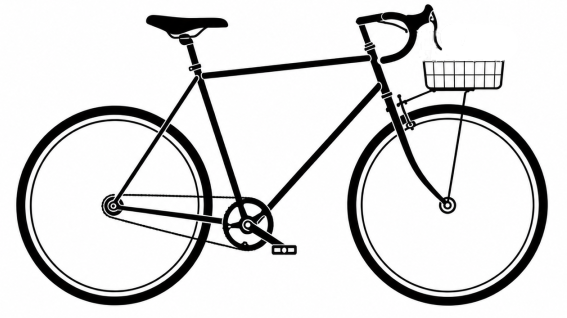
A tried and true method is to use a bicycle as a truing stand. Flip your bike upside down (or put it in a workstand), leave the wheel in the dropouts, and you have an axle mount that is perfectly matched to your axle. For a rim-brake bike, the brake pads are your lateral reference to visualize the wobble, allowing you to toward or away from spots that stand out.
Another and perhaps better way is to strategically attach zip ties. Cinch a zip tie around each fork blade (or seatstay) and trim the tail so it just clears the rim sidewall. Snip a little at a time until it barely scrapes at the highest point. A zip tie tail is a surprisingly sensitive indicator. You can hear a scrape of a quarter millimeter, and you get one on each side of the rim, which brake pads on a centered caliper also give you. Zip-ties are also be slightly adjustable by turning them one way or the other on the frame.
This method does have some limitations. Firstly, it’s awkward. You’re potentially working at an odd height, the wheel is captive in the frame, and checking dish means pulling the wheel repeatedly. It works, but is can be slow. Also it’s not really all that portable. And getting the proper alignment of things things like brakes or zip-ties takes some practice.
Option two: the old fork
If you have a retired steel fork, and if you’re reading this site you may already have three, you have the makings of a proper bench stand. Clamp the steerer in a bench vise, or better, bolt the fork to a plank: drill a hole for the steerer through a block screwed to a plywood base, and clamp the fork crown down. Drop the wheel in, close the quick release, and add the zip ties.
This gets the wheel to bench height, holds it dead rigid, and costs little to nothing. The dropouts locate the axle exactly the way a frame does, which is the only alignment that matters in the end. Plenty of good wheels have been built on exactly this rig. Its limitation is width. A front fork takes front wheels (100 mm spacing). For rear wheels some have cut the triangle from a scrap frame, but that’s probably overkill, considering there are far easier ways to build a stand. Also these methods are limited to the spacing between the dropouts. A 135 mm rear hub wont fit into a 100 mm fork for truing.
Option three: build your own
If you’re really set on having your own actual truing stand and still don’t want to buy one, an excellent one can be built. There are many plans online, and Roger Musson’s book Wheel Building details one of the most elegant designs we’ve seen. Because these resources are easy to come by, we’re not going into detailed plans here. But the takeaways are: The materials can basically be whatever you want, as long as the stand meets the rigidity and reference-point criteria listed above. Wood is rigid, light and easier to work with than metal. The base should be wide and somewhat heavy or able to be securely attached to your work surface so as to not tip over when spinning the wheel and turning nipples. Always use a dishing tool if you want truly accurate dish.
How true is true enough?
A lateral wobble under 0.5 mm is a considered well-built wheel. But there’s something really satisfying about dialing in a wheel so round and true that the imperfections are virtually undetectable. I’ll be honest though, I’ve built a bad wheel myself that looked perfect on the stand, but lost its shape after about 20 miles. The truth is that a perfectly true wheel on the stand wont stay that way on the bike if the principals of the craft aren’t followed. This is what separates a good wheel from an ok or even bad wheel, and really it comes down the builder not the stand.
If there is anything we’re trying to say in this somewhat bloated treatise it is this:
Wheel building rewards patience and punishes hastiness, sloppiness and thoughtlessness. A truing stand is a simple device that can cost virtually nothing or an entire paycheck.
There’s an old adage that goes, “It is a poor craftsman that blames their tools.” And just like this year’s winner of the Tour de France could probably beat 99 percent of cyclists while riding a huffy, a good, competent wheel builder can put together a durable, well built wheel using bike forks and zip ties.
The good news is this: not everyone can win the Tour de France, but pretty much anybody can learn to build a good wheel and the truing stand is only a small part of the equation.